

Is Priyanka Replacing Rahul?
Quiet Power Shift Inside Congress
Is Priyanka Replacing Rahul?
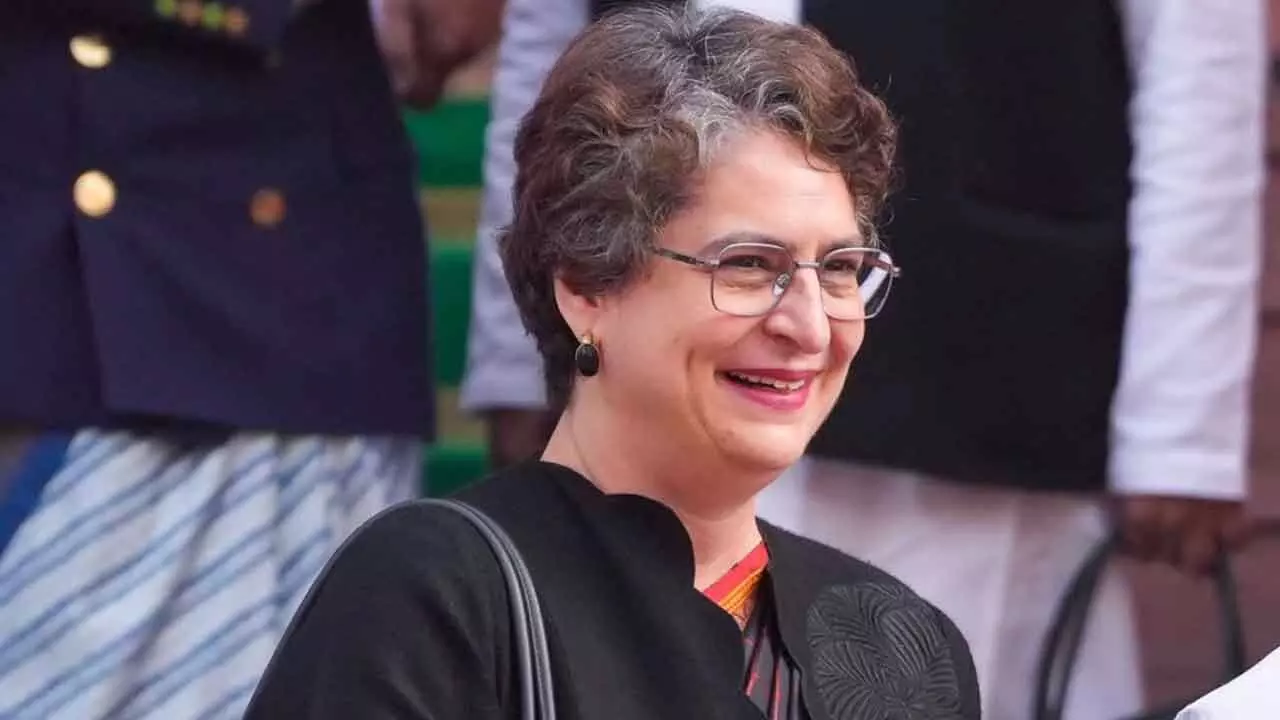

As speculation swirls around the Congress leadership, this op-ed examines the unmistakable signals emerging from Parliament that point to a quiet but consequential shift within the party.
With Rahul Gandhi’s leadership increasingly questioned after repeated electoral setbacks, Priyanka Gandhi Vadra’s growing visibility, political ease, and willingness to engage across party lines suggest more than mere symbolism.
From parliamentary conduct to internal party dynamics, the piece probes whether the Congress is edging towards a dual power centre—or an eventual transition. It argues that revival will depend not on charisma or lineage, but on pragmatic leadership, organisational rebuilding, and political seriousness
As 2025 draws to a close, the Indian National Congress finds itself once again at a familiar—but now intensified—crossroads. For years, Priyanka Gandhi Vadra functioned as the party’s “break-glass-in-case-of-emergency” option: a charismatic presence held in reserve while Rahul Gandhi remained the principal political face. That glass now appears to be cracking, if not shattering.
After what the BJP repeatedly brands as “95 electoral defeats” under Rahul Gandhi’s leadership, his credibility as a dependable challenger has steadily eroded and that the party was ready for a reset. It has coincided with growing unease within the Congress about leadership, strategy, and political temperament.
In that vacuum, Priyanka Gandhi’s increasing visibility during the Winter Session of Parliament has been read by many as a signal—perhaps even a trial run—for a larger role.
Congress leaders privately concede that the party is grappling with a crisis of confidence in Rahul Gandhi’s leadership. While Rahul continues to dominate ideological campaigns and street rhetoric, many believe that the granular work of parliamentary management, alliance-building, and political negotiation requires a different temperament—one they increasingly associate with Priyanka. Unlike Rahul, who often prefers sharp rhetoric and public confrontation, Priyanka is being projected as more open to inclusivity, dialogue, and tactical engagement.
Politics, after all, is also about optics—and the optics from this Parliament session were telling. Soon after the conclusion of every session, the Lok Sabha Speaker traditionally hosts an informal “Chai pe Charcha.”
This time, in Rahul Gandhi’s absence due to foreign travel, Priyanka Gandhi attended the gathering. Seated in the front row alongside Prime Minister Narendra Modi and Defence Minister Rajnath Singh, she appeared relaxed, engaged, and visibly at ease.
The contrast was striking. While Rahul Gandhi frequently complains about being excluded from government-organised events, he also has a track record of skipping parliamentary meetings and informal interactions.
Priyanka, by contrast, not only attended the Speaker’s tea but was seen exchanging pleasantries with the Prime Minister—sending out a subtle but unmistakable message that she is open to dialogue, even across ideological lines. During the session, she had also called on Union Minister Nitin Gadkari to discuss highway issues in Wayanad, further underlining her willingness to maintain cross-party working relationships.
Unsurprisingly, comparisons between the siblings’ political styles have intensified within Congress circles. Many leaders believe Priyanka’s approach—less performative, more transactional—could benefit a party that has often confused outrage with strategy.
Some supporters go further, invoking her resemblance to Indira Gandhi and citing her aggressive stand during the VB–Gram G Bill debate, which replaced MGNREGA, as evidence of political steel.
This inevitably raises the uncomfortable question: is the Congress preparing to sideline Rahul Gandhi and project Priyanka as its principal leader, or even a future prime ministerial face? Officially, the party insists otherwise. Unofficially, fault lines are becoming visible. Congress MP Imran Masood has already fuelled speculation by openly praising Priyanka’s leadership potential, prompting whispers of a looming sibling showdown.
In Odisha, Congress leader Mohammed Moquim was suspended after publicly calling for the removal of Rahul Gandhi and party president Mallikarjun Kharge, proposing Priyanka Gandhi as the leader who could rescue the party. Even allies have begun voicing discomfort.
CPI(M) MP John Brittas criticised Rahul Gandhi for leaving the country during a crucial parliamentary session, questioning his seriousness at a time when the Opposition was expected to be fully present and combative.
Critics—both within the Congress and among its allies—now believe a transition may be closer than the leadership admits. They argue that Priyanka could soon assume day-to-day political management, even if Rahul continues as the ideological figurehead.
Proponents like Imran Masood argue that Priyanka’s decisive communication style and political instincts make her the ideal “front” to revive the Congress’s battered image. Her husband, Robert Vadra, has added fuel to the debate, declaring it “just a matter of time” before she assumes a top leadership role, while also expressing his own desire to enter active politics.
This raises a trillion-rupee question: is this moment about reviving the Congress—or about a struggle for control between the two children of Sonia Gandhi?
Senior Congress leaders dismiss such speculation as BJP-driven wishful thinking. Yet history offers cautionary lessons. Post–Jawaharlal Nehru, the Congress has fractured repeatedly. Indira Gandhi herself was once derided as a “Goongi Gudiya,” only to emerge as an iron-willed leader who split the party and centralised power with near-authoritarian resolve. Given that legacy, another internal rupture—or at least a serious contest for supremacy—within today’s diminished Congress cannot be ruled out.
What the party clearly needs, however, is not just charisma or pedigree. It needs pragmatic leadership—someone who understands the politics of give-and-take, negotiation, and institution-building. Constant venom against the ruling party, unaccompanied by strategy, has yielded little electoral dividend.
Loyalists may compare Priyanka’s looks and oratory to Indira Gandhi, but such comparisons are premature and misleading. No one can match the looks and oratory of Indira Gandhi who was a formidable political operator—something that lineage alone cannot confer.
Nor is charisma sufficient in today’s political landscape. Sceptics rightly point to Priyanka’s inability to revive the Congress in Uttar Pradesh, where her campaign failed to arrest the party’s decline. Moreover, she carries the same “Naamdar” baggage that the BJP has weaponised with devastating success for over a decade.
The Congress can survive—and possibly revive—only by rebuilding its organisational backbone, shedding sycophantic cheerleaders, empowering capable leaders, and forging pragmatic regional alliances. Priyanka can be a game changer only if she demonstrates these qualities in practice, not merely in symbolism.
Encouragingly, during the Winter Session, she displayed signs of seriousness. She arrived in Parliament ahead of schedule, made visible efforts to understand procedures, and maintained a proactive presence across debates and discussions.
Sources within the party say she believes Congress has sidelined experienced parliamentarians like Shashi Tharoor and Manish Tewari and wants their voices to be amplified.
For now, many leaders appear willing to give her space. They note that unlike Rahul, Priyanka frames questions in Parliament in ways that compel government responses rather than mere dismissal. That alone makes her harder to ignore.
So, is the Congress now developing two power centres? Time will tell. But one thing is unmistakable: the seemingly innocuous cup of tea hosted by the Lok Sabha Speaker offered a revealing glimpse into the Congress’s evolving internal politics.
Priyanka Gandhi has signalled that she is ready to play an active role—not merely as a surname or a symbol, but as a political actor seeking relevance in a party desperate for renewal.
(The author is a former Chief Editor at The Hans India)





